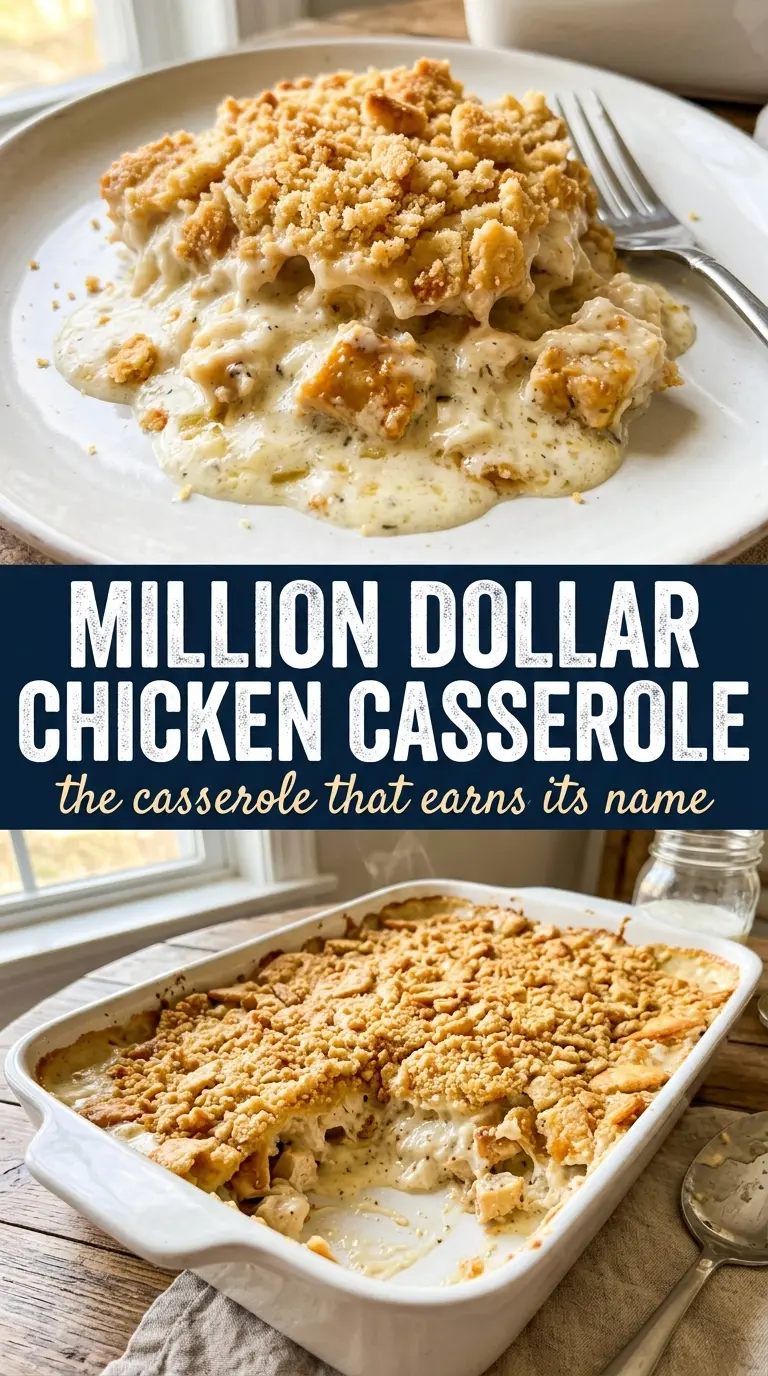
Million Dollar Chicken Casserole is the kind of bake that disappears fast because it hits every note people want from comfort food: creamy in the middle, savory through the chicken, and crowned with a buttery Ritz crust that stays crisp enough to crack under a spoon. The filling bakes up rich without turning heavy, and the ranch seasoning gives it that familiar, no-nonsense flavor that keeps people going back for another scoop.
The trick is in the texture balance. Softened cream cheese blends smoothly with sour cream and condensed soup, which keeps the base luscious instead of dry or grainy, and folding in the chicken after the dairy mixture is already smooth helps everything coat evenly. The cracker topping goes on right before baking so it browns on top instead of soaking into the filling.
Below, you’ll find the few details that matter most: how to keep the casserole creamy, how to get the topping deeply golden, and which substitutions still give you a dish worth serving.
The filling stayed creamy all the way through and the Ritz topping came out beautifully crisp. I used rotisserie chicken and it was on the table in under an hour.
Save this Million Dollar Chicken Casserole for nights when you want a creamy chicken bake with a buttery Ritz crust and almost no fuss.
The Creamy Filling Works Only If You Start Smooth
Most casseroles that lean on cream cheese fail for one reason: the dairy base never fully blends before the chicken goes in. That leaves little pockets of cream cheese that stay dense after baking, and the whole dish can feel uneven instead of rich. Here, the cream cheese, sour cream, soup, and ranch seasoning get whisked together first, and that matters more than people think.
Once the base is smooth, the chicken folds in without much effort, and every piece gets coated in the same creamy mixture. The filling should look thick and spreadable, not runny. If it seems loose before baking, it usually means the cream cheese wasn’t soft enough or the chicken was still carrying a lot of moisture.
What Each Ingredient Is Actually Doing in This Baked Chicken
- Chicken breasts (the protein) — Pat dry so they brown instead of steam. Even thickness ensures uniform cooking.
- Sauce or cooking liquid (the moisture keeper) — This prevents the chicken from drying out in the oven. Balance richness with acid.
- Garlic (the aromatic foundation) — Fresh minced garlic mellows and becomes sweet when baked. Don’t brown it or it turns bitter.
- Cream or wine (optional richness) — This adds luxury and moisture. Don’t let it boil hard or it can break and separate.
- Lemon or white wine (the brightness) — Acid prevents heavy sauces from tasting flat. Balance is essential.
- Fresh herbs (basil, thyme, parsley) — Add some during cooking and some after so you get both cooked and fresh flavors.
- Cheese (optional richness) — Parmesan or feta adds depth. Don’t overdo it or the dish becomes heavy.
- Proper oven temperature (375-400°F) — This temperature bakes chicken through without drying the edges. Use a thermometer for 165°F.
What the Ritz Topping Is Doing That Breadcrumbs Won’t
- Ritz crackers — These give the casserole its signature buttery crunch. Standard breadcrumbs won’t taste the same and usually bake up drier; Ritz crackers bring their own richness, which is why the topping feels like part of the dish instead of a separate layer.
- Cream cheese — This is the backbone of the filling. Use full-fat cream cheese for the best texture; low-fat versions can bake up looser and a little chalky. Let it soften completely so it blends without lumps.
- Rotisserie chicken or leftover cooked chicken — This is one place where convenience works. Rotisserie chicken adds good flavor and saves time, but any cooked chicken works as long as it’s shredded into bite-size pieces so it mixes evenly.
- Ranch seasoning — It pulls the whole casserole together with salt, herbs, and a little tang. If you only have homemade ranch-style seasoning, use it, but don’t skip the seasoning layer entirely or the casserole tastes flat against all that dairy.
- Cheddar — Sharp cheddar gives the filling a stronger, saltier edge and keeps the casserole from tasting one-note. Mild cheddar works, but the final dish tastes softer and less defined.
The 20 Minutes That Decide the Final Texture
Building the Base
Heat the oven to 350°F and grease the baking dish well so the edges release cleanly. Beat the softened cream cheese, sour cream, soup, and ranch seasoning until the mixture is fully smooth. If you still see streaks of cream cheese, keep mixing; those streaks turn into dense spots in the finished casserole.
Folding in the Chicken
Add the shredded chicken, cheddar, and garlic powder, then stir just until everything is coated. The filling should look thick and cohesive, not soupy. If the chicken was very wet, pat it dry first or the casserole can turn loose in the center.
Making the Cracker Crust
Mix the crushed Ritz crackers with melted butter until every crumb is moistened. The topping should hold together in sandy clumps, not sit in dry crumbs with pools of butter underneath. Spread it evenly over the filling so the whole surface browns at the same pace.
Baking Until Bubbling
Bake until the edges are bubbling and the topping is deeply golden, 30 to 35 minutes. If the top is browning too fast, tent it loosely with foil for the last few minutes. Let the casserole sit for about 10 minutes before serving so it settles and scoops neatly instead of running across the plate.
How to Adjust This Casserole Without Losing the Comfort Food Feel
Make it gluten-free
Use a gluten-free condensed chicken soup and swap the Ritz crackers for a gluten-free buttery cracker. The filling stays the same, but the topping will be a little more delicate, so press it on gently instead of packing it down.
Make it lighter without losing the creamy texture
You can use reduced-fat sour cream, but keep the full-fat cream cheese if you want the casserole to stay luscious. Going low-fat across the board tends to make the filling looser and less satisfying, which is the tradeoff here.
Add vegetables without watering it down
Stir in cooked broccoli, peas, or small diced spinach that has been squeezed dry. Raw vegetables release too much water and can thin the filling, but pre-cooked and well-drained additions fit in easily.
Storage and Reheating
- Refrigerator: Store covered for up to 4 days. The topping softens a bit, but the filling stays creamy.
- Freezer: This casserole freezes well before baking. Assemble it without the cracker topping, wrap it tightly, freeze for up to 2 months, then add the topping just before baking.
- Reheating: Reheat covered at 325°F until warmed through, then uncover for a few minutes to re-crisp the top. Microwaving works in a pinch, but it softens the crust and can make the filling separate at the edges.
Answers to the Questions Worth Asking

Million Dollar Chicken Casserole
Ingredients
Equipment
Method
- Preheat the oven to 350°F and grease a 9x13 baking dish with a light coat of fat so the casserole releases easily after baking.
- Beat together cream cheese, sour cream, cream of chicken soup, and ranch seasoning until smooth and fully combined.
- Fold in shredded chicken, cheddar cheese, and garlic powder, then season with salt and pepper to evenly distribute flavor.
- Spread the chicken mixture evenly into the prepared dish to form a level layer for consistent baking.
- Mix crushed Ritz crackers with melted butter until evenly combined, then spread over the chicken layer in an even coating.
- Bake at 350°F for 30-35 minutes until bubbly at the edges and the cracker crust is deeply golden.
- Remove from the oven and garnish with fresh chives before serving.