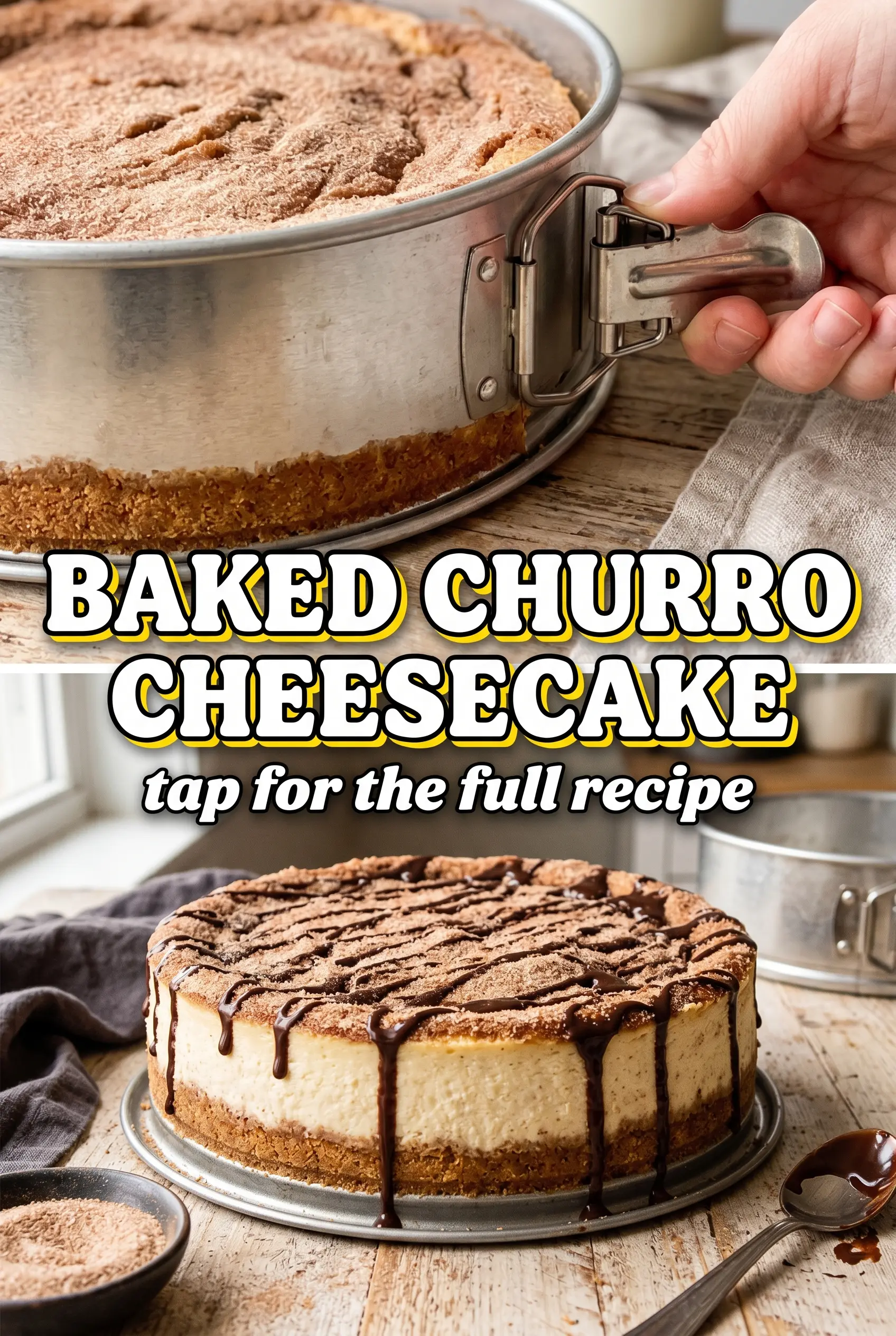
Creamy churro cheesecake hits the exact balance that makes dessert disappear fast: a silky baked filling, a cinnamon-sugar crust, and pockets of churro pieces that stay tender instead of turning muddy. The chocolate drizzle on top gives it the same finish you’d want from a plate of warm churros, but in a sliceable cheesecake that feels a little more special without being fussy.
What makes this version work is the layering. The crust gets a short bake so it sets before the filling goes in, which keeps it from going sandy under the weight of the batter. The cream cheese mixture stays on the low side for mixing speed, too. That’s how you keep air bubbles down and avoid the cracks that happen when cheesecake gets whipped too aggressively. Folding the churro pieces in at the end keeps them from breaking apart before they hit the oven.
Below, I’ve included the detail that matters most for getting a clean slice and a few smart swaps for when you only have store-bought churros or want to adjust the toppings.
The cheesecake baked up smooth with no cracks, and the churro pieces stayed soft inside the filling instead of getting soggy. The dulce de leche swirl made every slice taste like a churro sundae.
Save this churro cheesecake for the dessert night when you want a cinnamon-sugar crust, creamy filling, and a chocolate finish all in one slice.
The Reason Churro Cheesecake Stays Creamy Instead of Cracking
Cheesecake cracks for predictable reasons: too much air in the batter, overbaking, or a sudden temperature change after it comes out of the oven. This recipe avoids the first one by keeping the mixer on low once the eggs go in. That slow finish matters more than people think. High-speed mixing puffs the batter, and puffed batter deflates in the oven, which is when cracks start to form.
The second mistake is chasing a fully firm center. Pull this cheesecake when the edges look set and the middle still has a slight wobble, like soft gelatin. It will finish setting as it cools. If you wait until the center looks completely still in the oven, you’ve usually gone too far and the texture gets dense and dry instead of creamy.
The other detail that pays off is the rest time. Four hours is the minimum, but overnight gives the cleanest slices and lets the churro pieces settle into the filling without weeping.
What Each Ingredient Is Actually Doing in This Churro Cheesecake
- Cinnamon sugar graham cracker crumbs — These give you the base flavor fast, and the cinnamon bakes right into the crust so the first bite already tastes like a churro. If you only have plain graham crumbs, add a little extra cinnamon and sugar, but the cinnamon-sugar version has the best payoff for almost no extra work.
- Butter — Melted butter binds the crumbs and helps the crust bake into a firm layer that slices cleanly. Too much butter makes the base greasy, while too little leaves it loose and sandy.
- Cream cheese — Use full-fat blocks here, not spreadable tub cream cheese. The block style gives you the structure and tang that hold up during baking. If the cream cheese is still cool, the batter turns lumpy and you end up overmixing to smooth it out, which is how you trap air.
- Sour cream — This loosens the filling just enough and adds a little tang so the cheesecake doesn’t taste flat under the cinnamon and chocolate. Greek yogurt works in a pinch, but the texture is a touch less rich.
- Churro pieces — Fresh or store-bought both work, but they should be chopped into small, even bits so they suspend in the batter instead of sinking. Very soft churros can disappear into the filling, so slightly stale ones actually hold up better here.
- Dulce de leche and chocolate sauce — The dulce de leche swirls through the center and adds a caramel note that echoes the churro coating. The chocolate drizzle is for the finish, so use a sauce that pours smoothly; if it’s too thick, warm it for a few seconds first.
Building the Layers So the Churro Pieces Don’t Sink
Pressing and Prebaking the Crust
Mix the cinnamon sugar graham crumbs with the melted butter until every crumb looks evenly moistened, then press it firmly into the bottom of the springform pan. You want a packed layer, not a loose sprinkle, because a weak crust will break apart when you cut the first slice. The short bake sets the butter and gives the crust a toasted edge that tastes more like a real churro coating than a raw cookie base. Let it cool slightly before the batter goes in so the filling doesn’t start melting the butter back out.
Mixing the Filling Without Whipping Air Into It
Beat the cream cheese and sugar until the mixture looks smooth and glossy, then add the sour cream, vanilla, cinnamon, and nutmeg. Once the eggs go in, keep the mixer on low and stop as soon as each egg disappears. If you see the batter getting fluffy instead of satiny, you’ve gone too fast. That extra air expands in the oven and can give you a puffy top that collapses later.
Layering the Churros and Dulce de Leche
Fold in the chopped churro pieces by hand so they stay in chunks. Pour in half the batter, drizzle the dulce de leche over that layer in loose swirls, then cover it with the remaining batter. The goal is a hidden ribbon, not a fully mixed caramel layer, because over-stirring the dulce de leche muddies the filling and makes the swirl disappear.
Knowing Exactly When to Pull It From the Oven
Bake until the edges are set and the center still has a gentle jiggle when you shake the pan. That wobble should look contained, not sloshy. If the center is firm in the oven, the cheesecake will be overbaked by the time it cools. Let it cool completely at room temperature before refrigerating it, or the sudden chill can tighten the surface and encourage cracks.
Three Ways to Change the Finish Without Losing the Churro Idea
Dairy-Free Version That Still Slices Cleanly
Use a dairy-free cream cheese that’s designed for baking and swap in a thick dairy-free sour cream or coconut yogurt. The texture will be a little softer and the tang less sharp, but you’ll still get a smooth, sliceable cheesecake if you chill it overnight. Keep the churro topping dairy-free too by choosing a sauce that doesn’t rely on butter or cream.
Gluten-Free Crust and Filling-Friendly Swap
Use gluten-free graham-style crumbs in place of the regular ones, and check that your churros are made with a gluten-free batter if that matters for your crowd. The filling itself is naturally gluten-free, so the crust and churro pieces are the only parts that need attention. The finished cheesecake keeps the same creamy center and cinnamon finish.
Less Sweet, More Cheesecake-Forward
Cut the granulated sugar slightly and use a lighter hand with the chocolate drizzle if you want the tang of the cream cheese to come through more clearly. You’ll lose a little of the candy-shop feel, but the cheesecake tastes cleaner and the churro pieces stand out more. This is the version I’d make when serving it after a heavy meal.
Storage and Reheating
- Refrigerator: Keep covered for up to 5 days. The churro pieces soften a bit more each day, but the cheesecake still slices well.
- Freezer: Freeze whole or in slices, wrapped tightly and then sealed in a freezer bag, for up to 2 months. Thaw in the refrigerator overnight for the best texture.
- Reheating: Cheesecake isn’t meant to be reheated. Serve it cold or let slices sit at room temperature for 15 to 20 minutes so the filling softens without losing its structure.
Questions I Get Asked About This Recipe
Churro Cheesecake
Ingredients
Equipment
Method
- Preheat oven to 325°F. Mix cinnamon sugar graham cracker crumbs with melted butter and press firmly into the bottom of a 9-inch springform pan, so the layer is even.
- Bake crust for 8 minutes, until set and fragrant. Let cool slightly in the pan with a firm, compact crust visible.
- Beat cream cheese and granulated sugar until smooth, scraping the sides for a lump-free texture. The mixture should look glossy and thick.
- Add sour cream and vanilla extract, then beat until fully combined. Stop when the batter looks smooth and creamy.
- Mix in cinnamon and nutmeg until evenly distributed. You should see consistent speckling with no dry streaks.
- Add eggs one at a time, beating on low speed after each addition. Stop as soon as each egg disappears into the batter for a silky consistency.
- Fold in chopped churros so pieces are suspended throughout the batter. The batter should show churro bits evenly across the surface.
- Pour half the cheesecake batter over the crust and spread gently to level it. The first layer should cover the crust completely.
- Drizzle dulce de leche over the batter in a swirl pattern. Create visible caramel ribbons before adding more batter.
- Pour the remaining cheesecake batter on top and smooth the surface. The dulce de leche should be partially covered but still marbled in places.
- Bake for 40-50 minutes at 325°F until the cheesecake is set at the edges but the center still jiggles slightly when gently shaken. Look for a soft wobble in the middle rather than a fully firm center.
- Cool completely at room temperature, about 1-2 hours. The cheesecake should stop steaming and look fully relaxed with a stable top.
- Refrigerate for at least 4 hours to firm up the texture. The center should slice cleanly after chilling.
- Drizzle chocolate sauce over the chilled cheesecake just before serving. Use a zigzag or spooned streaks so the chocolate is visible on each slice.